| Requirement | EU (AI Act) | US (EO 14179) |
|---|---|---|
| Risk classification | Mandatory 4-tier system | None |
| Pre-market conformity assessment | Required for high-risk | Not required |
| Technical documentation | Detailed, auditable | No federal requirement |
| Human oversight mechanisms | Mandatory for high-risk | Voluntary |
| Transparency obligations | Extensive (including for GPAI) | Limited to sectoral rules |
| Penalties | Up to €35M / 7% turnover | No federal AI-specific penalties |
| Data governance requirements | Specific to AI training data | General (existing privacy laws) |
The EU AI Act vs. The US Executive Order: A Founder's Survival Guide
Two regulatory philosophies. One company. Here's the compliance matrix every cross-border AI founder needs before August 2026.
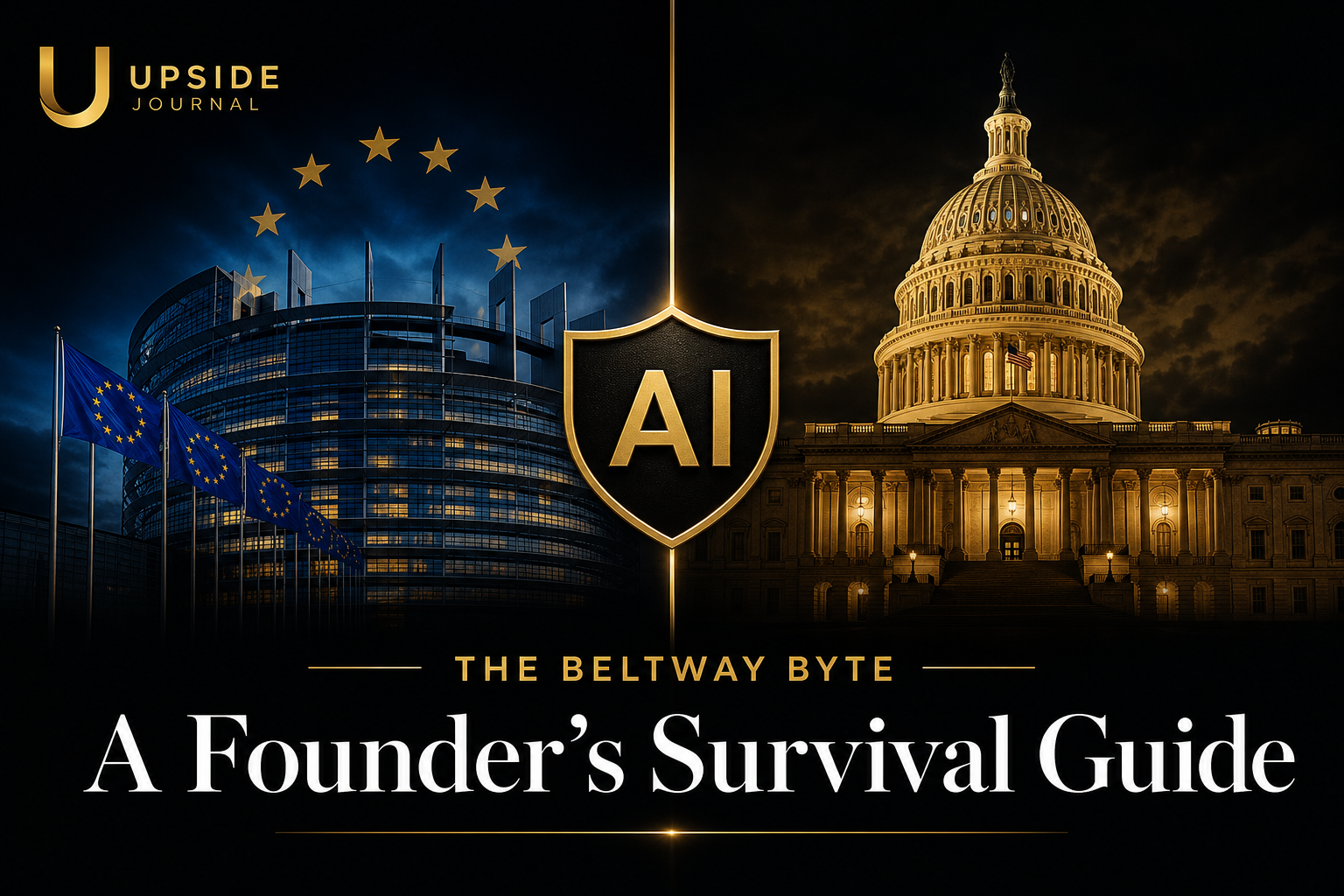
If you're building an AI company in 2026, you're now operating under two fundamentally different regulatory philosophies — and the gap between them is widening by the month.
On one side: the European Union, whose AI Act is entering its most consequential implementation phase. On the other: the United States, where Executive Order 14179 has accelerated a systematic deregulation agenda that explicitly prioritises innovation over precaution.
The result is a regulatory schism that every cross-border founder needs to understand — not in abstract policy terms, but as a concrete operational challenge with real compliance costs and real market access implications.
## The EU AI Act: Where We Are Now
The EU AI Act entered into force on 1 August 2024, but its requirements are applying in stages. Here's the timeline that matters:
**Already active (since February 2026):** The European Commission published guidance on prohibited AI practices — including social scoring systems, real-time biometric identification in public spaces (with exceptions), and AI systems that exploit vulnerabilities. If you're building anything in these categories, the clock has already started.
**August 2026:** The big one. Requirements for **high-risk AI systems** become enforceable. This covers AI used in critical infrastructure, education, employment, law enforcement, migration, and democratic processes. If your product touches any of these sectors in the EU, you need conformity assessments, risk management systems, data governance frameworks, human oversight mechanisms, and technical documentation — all in place before August.
**August 2027:** Providers of General-Purpose AI (GPAI) models that were already on the market must comply. This is the deadline that matters for foundation model providers who were selling into Europe before the Act took effect.
Member States are simultaneously designating national competent authorities, setting up market surveillance, and defining penalty regimes. Fines scale to **€35 million or 7% of global annual turnover** for the most serious violations. This isn't theoretical. The enforcement infrastructure is being built now.
## The US Executive Order: A Different Philosophy
Executive Order 14179, signed in January 2025 under the title "Removing Barriers to American Leadership in Artificial Intelligence," took the opposite approach. The order explicitly revoked the previous administration's AI safety framework and directed federal agencies to remove regulatory barriers to AI adoption.
The philosophy is stated plainly in the order: *"To win, United States AI companies must be free to innovate without cumbersome regulation."*
Since then, the administration has gone further. A December 2025 executive action aimed to pre-empt state-level AI regulation, arguing that a patchwork of 50 different regulatory regimes creates compliance challenges — particularly for startups. The order specifically targeted Colorado's algorithmic discrimination law as an example of state regulation that could "force AI models to produce false results."
The practical effect: US-based AI companies face minimal federal regulatory burden. No mandatory risk assessments. No conformity requirements. No pre-market approval for high-risk applications. The regulatory friction that EU companies are building compliance teams to manage simply doesn't exist on the American side.
## The Founder's Compliance Matrix
For founders operating across both markets, the divergence creates a concrete operational challenge:
The practical question for any cross-border AI startup: **do you build to the EU standard globally, or maintain two separate compliance tracks?**
## The Strategic Calculation
Most serious founders are converging on the same answer: **build to the EU standard as your baseline.**
The logic is economic, not ideological. The EU represents 450 million consumers and some of the world's largest enterprise buyers. Locking yourself out of the European market to save on compliance costs is a strategic error that compounds over time — especially as other jurisdictions (Canada, Brazil, Japan, South Korea) develop their own frameworks that increasingly reference the EU model.
Building EU-compliant from day one also creates a competitive moat. When enterprise procurement teams evaluate AI vendors, a company that can demonstrate conformity assessment documentation, risk management systems, and data governance frameworks signals maturity that a non-compliant competitor cannot match.
## A 4-Step Survival Framework
**1. Classify your risk tier now.** Map your AI system against the EU's four-tier classification (unacceptable, high, limited, minimal risk). If you're high-risk, August 2026 is your hard deadline. Don't wait for enforcement actions to discover where you sit.
**2. Build documentation as a product feature.** The technical documentation requirements — data provenance, model architecture, testing results, performance metrics — shouldn't be a compliance afterthought. Build documentation pipelines into your development workflow. What the EU requires is what good engineering looks like anyway.
**3. Design for human oversight.** The AI Act's human oversight requirements aren't just a checkbox. Build meaningful human-in-the-loop controls for high-stakes decisions. This isn't about compliance theatre — it's about building AI systems that enterprise customers actually trust.
**4. Monitor the state-level landscape.** Even in the US, the federal deregulation posture may not hold uniformly. States like California, Illinois, and New York continue to advance their own AI governance frameworks. The pre-emption battle is far from settled.
The regulatory divergence between the EU and US will define the competitive landscape for AI companies for the rest of this decade. The founders who treat compliance as a strategic asset — not a cost centre — will be the ones who build companies that scale across both markets.
### Read Next
[
MARKET SIGNAL
#### SaaS Metrics That Matter: Why Churn Rate Is the New Fundraising Metric
](/articles/saas-churn-metric)
[
THE STACK
#### How Microsoft-Backed Startups Are Rewriting the Event ROI Playbook
](/articles/microsoft-event-roi-playbook)
[
DEAL FLOW
#### Africa's Hidden Unicorns: 5 Startups Western VCs Are Ignoring
](/articles/africa-hidden-unicorns)
[
CONTRARIAN
#### Cannes Lions Is a $3 Billion Networking Failure — Here's the Data
](/articles/cannes-3b-networking-failure)
### Don't miss what matters.
Get Upside Journal's sharpest analysis — free, in your inbox.