


The Executive AI Stack: 10 Tools Replacing Traditional Management Work
Executive AI Stack: 10 AI Tools Replacing Management Work

Executive Summary
Traditional management work — status reporting, resource allocation, performance tracking, meeting synthesis, and cross-team coordination — is being absorbed by a new category of enterprise software: agentic AI systems that plan, execute, and report without constant human direction. Gartner projects that 40 percent of enterprise applications will embed task-specific AI agents by the end of 2026, up from under 5 percent in 2025, and that agentic AI software revenue will reach $450 billion by 2035.
This is not a productivity story about faster spreadsheets. It is a structural shift in what a manager's job actually is. The Executive AI Stack maps the ten categories of tools now performing work that used to require a layer of human middle management: planning, monitoring, synthesizing, and deciding. Executives who understand this stack can restructure their organizations deliberately. Those who don't will have the restructuring done to them.
Introduction
For most of the twentieth century, management existed to solve an information problem. A CEO could not personally track the status of every project, every account, every hire, and every budget line, so organizations built layers of managers whose primary job was aggregation: collect data from below, synthesize it, and pass a summary upward. Gary Hamel and Michele Zanini's often-cited estimate put the average span of control at one manager per 4.7 workers — a ratio dictated almost entirely by how much status-tracking a single human brain could absorb.
Agentic AI removes the ceiling on that ratio. Software agents that can read a project management board, cross-reference it against a budget, flag variance, draft the update, and route it to the right stakeholder do not get tired at forty reports. McKinsey's 2026 Global Tech Agenda argues that the next generation of technology leaders will not just manage technology; they will design their companies around it — and the first place that redesign is visible is in the tools now sitting on an executive's desktop.
This article catalogs the ten tool categories forming what we call the Executive AI Stack: the layer of agentic software increasingly responsible for work that, as recently as 2023, required a trained human manager. For each category we outline what it replaces, what it does not yet replace, and how operators should sequence adoption.
Why This Shift Is Happening Now
Three forces have converged to make 2026 the inflection year for executive-facing agentic AI.
* Model reliability crossed a usability threshold. Multi-step reasoning and tool-calling accuracy improved enough that agents can complete multi-hop workflows — pull data, reconcile it, draft output — without constant supervision.
* Enterprise software vendors shipped agent frameworks natively. Rather than bolting AI onto existing tools, categories like project management, CRM, and BI platforms rebuilt core workflows around autonomous agents as a default mode.
* Cost pressure met headcount constraints. With hiring freezes common across mid-market enterprise, leaders are being asked to absorb coordination work that used to justify an additional management hire.
Gartner's 2026 CIO and Technology Executive Survey found that only 17 percent of organizations have deployed AI agents to date, yet more than 60 percent expect to do so within two years — the steepest adoption curve of any technology category the survey tracks. That gap between current deployment and near-term intent is precisely where executive decision-making now sits, and it connects directly to the broader shift The Upside Journal has tracked across the enterprise AI stack more generally.
The Executive AI Stack: Ten Categories
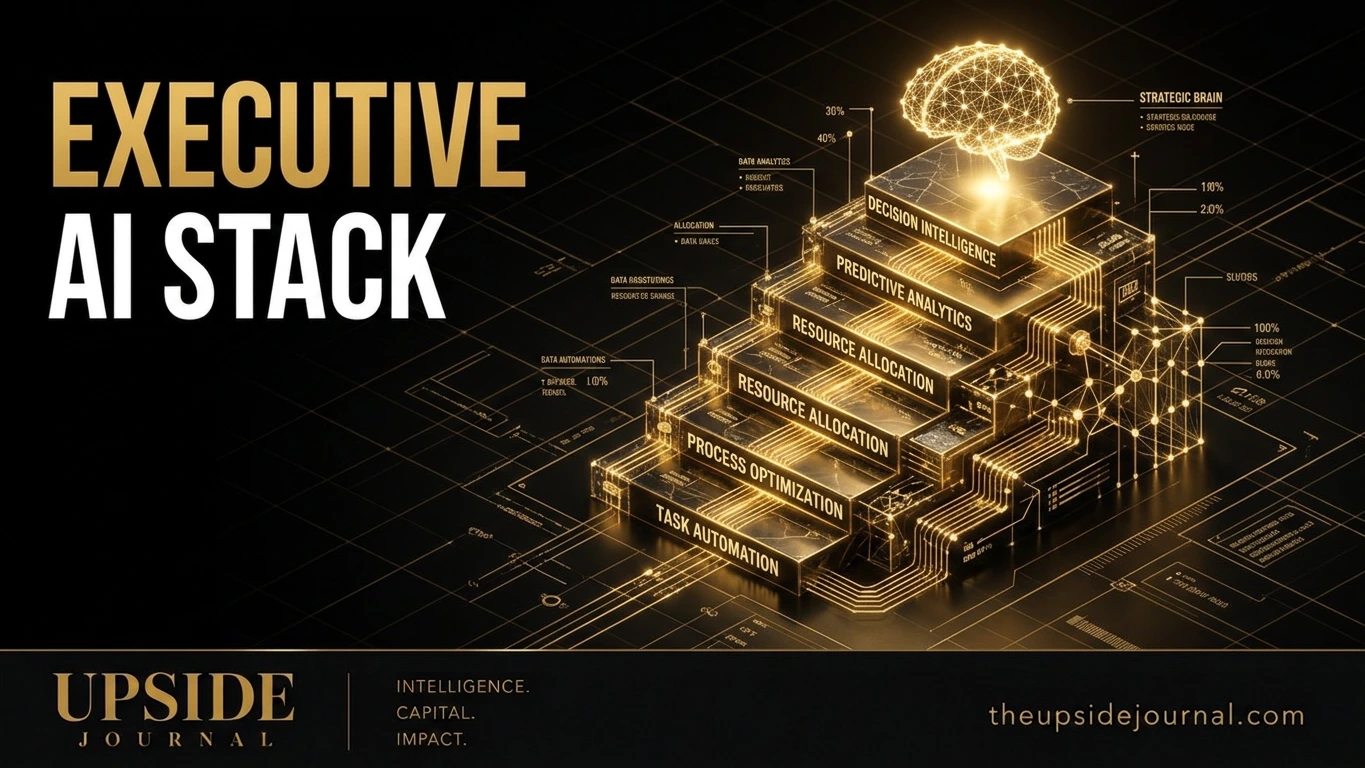
The stack is organized by managerial function rather than by vendor. Most enterprises will not adopt all ten in 2026; the goal is to understand which function each category replaces so that adoption can be sequenced against actual organizational bottlenecks rather than vendor marketing.
1. Status Synthesis Agents
These agents connect to project trackers, ticketing systems, and communication tools, then generate structured status reports on a schedule — without a human compiling them. They replace the weekly "gather updates and summarize" task that traditionally consumed a first-line manager's Friday afternoon.
judgment calls about which delays matter. A synthesis agent will flag that a task is late; it will not reliably tell you which late task threatens the quarter.
2. Resource Allocation Agents
Resource allocation agents ingest capacity data — hours logged, sprint velocity, budget burn — and recommend reallocation across projects or teams. This is the closest AI has come to automating the classic middle-management function of deciding who works on what.
Operators should treat the recommendation as a first draft, not a directive. The operator playbook for this category is to require a named human owner to approve any reallocation above a defined threshold, preserving accountability while removing the manual analysis burden.
3. Meeting Intelligence Agents
Meeting intelligence tools now do more than transcribe: they extract decisions, assign owners to action items, detect unresolved disagreements, and surface them in the next meeting's agenda automatically. This directly displaces the "meeting-after-the-meeting" work — the follow-up emails and task assignments a manager used to do by hand.
4. Performance Signal Agents
Rather than replacing performance reviews, these agents continuously aggregate signals — code commits, deal velocity, support ticket resolution, peer feedback — into a running dashboard, reducing the review cycle from a quarterly reconstruction exercise to a real-time read. This is one of the more contested categories: McKinsey's 2026 AI Trust Maturity Survey found that only about a third of organizations report governance maturity of three or higher for agentic systems, a gap that matters most where AI output touches compensation and promotion decisions.
5. Financial Variance Agents
These agents monitor budget-to-actual spend across departments and flag variance before month-end close, a task that previously required a finance business partner manually reconciling multiple systems. Deal Flow implications follow directly: faster variance detection compresses the reporting lag investors have historically tolerated in mid-market operating companies.
6. Hiring Pipeline Agents
Recruiting coordination — screening resumes against structured criteria, scheduling across calendars, and drafting candidate communication — is now substantially agent-driven. The category replaces the coordination layer of hiring, not the judgment layer; interview evaluation and final selection remain human.
7. Customer Health Agents
For B2B and enterprise SaaS operators, customer health agents synthesize usage data, support tickets, and renewal timelines into a single risk score, replacing the account manager's manual quarterly business review prep. Executives should note this is the category with the clearest, most measurable ROI, because churn is directly quantifiable.
8. Compliance Monitoring Agents
These agents continuously scan policies, vendor contracts, and regulatory filings against a compliance checklist, surfacing exceptions in near real time. Given the pace of AI-specific regulation, this category increasingly overlaps with the questions raised in our AI regulation playbook, particularly for organizations operating across US and EU jurisdictions.
9. Strategic Scenario Agents
Scenario agents run lightweight what-if modeling — the effect of a price change, a headcount cut, or a new market entry — against existing financial and operational data, compressing work that used to require a strategy or FP&A team to build a bespoke model. This category remains the least mature: outputs should be treated as a starting hypothesis, not a board-ready recommendation.
10. Cross-Functional Orchestration Agents
The most advanced category sits above the other nine: orchestration agents route information and tasks across the other categories, effectively acting as a coordination layer between departments. This is the closest current technology comes to replicating what a general manager does — and it is also the category with the least standardized governance, which is why the why agentic AI hype under-delivers conversation about governance debt applies most directly here.
The Operator Playbook
Adopting the Executive AI Stack is not a single procurement decision. It is a sequencing problem. Based on the deployment patterns we have tracked across mid-market operators, the following order minimizes governance risk while capturing early value.
* Start with synthesis, not decision-making. Status and meeting intelligence agents carry the lowest governance risk because their output is informational, not directive.
* Instrument before you automate. Financial variance and customer health agents only work if the underlying data is clean; garbage in produces confidently wrong variance flags.
* Require a named human owner for every category that touches compensation, hiring, or budget reallocation, with an explicit approval threshold.
* Audit governance maturity quarterly. Treat agent output the way you would treat a junior analyst's first draft — useful, but not final.
* Sequence orchestration last. Cross-functional agents inherit the governance gaps of every category beneath them; deploy only once the underlying nine are stable.
This sequencing mirrors the broader argument in our piece on operational leadership versus strategic leadership: the manager's job is bifurcating into a coordination function that AI increasingly performs, and a judgment function that remains stubbornly human. Leaders who conflate the two risk automating the wrong half.
Capital Implications
For investors and boards, the Executive AI Stack changes how operating leverage should be evaluated in a portfolio company. A management layer that used to scale linearly with headcount can now scale sub-linearly, which changes the unit economics case for Series B and C companies specifically. McKinsey estimates that AI-powered agents and workflow redesign could add roughly $2.9 trillion in annual US economic value by 2030 — a figure driven less by novel invention than by organizations restructuring workflows around agents rather than simply layering AI onto existing management structures.
This has a direct read-through for diligence: acquirers and LPs evaluating a company's management overhead should now ask not just how many managers a company employs, but which of the ten categories above that company has deployed, and how mature its governance is for each. Two companies with identical management headcount can carry very different structural risk depending on how much of that headcount is doing coordination work an agent could already perform.
Long Horizon View
Gartner's five-stage model for agentic AI adoption anticipates that by 2029, at least half of knowledge workers will create, govern, and deploy their own agents as a routine part of their job — a shift comparable to the arrival of the spreadsheet as a baseline professional skill. If that trajectory holds, the management layer of the next decade will look structurally different: fewer roles dedicated purely to status aggregation and coordination, and a growing premium on the judgment, negotiation, and accountability functions that remain distinctly human.
The organizations best positioned for that transition are not necessarily the ones adopting the most agents fastest, but the ones building governance discipline in parallel — treating each category in the stack as a system with an accountable human owner, not a black box that quietly absorbs a job description.
Contrarian Perspective
The dominant narrative treats the Executive AI Stack as a straightforward efficiency story: fewer managers, faster decisions, lower cost. The more uncomfortable read is that most organizations are automating the coordination work management was built to hide, without addressing the accountability gap that coordination work used to paper over.
When a status synthesis agent flags a delayed task, someone still has to decide whether that delay matters, escalate it, and own the consequence if it doesn't get fixed. Removing the manager who used to do the reporting does not remove the need for that judgment; it simply makes the absence of a clearly accountable human more visible, and often more costly, when something goes wrong. The organizations quietly struggling with agent adoption in 2026 are rarely struggling with the technology. They are struggling with the fact that they automated the paperwork of management without replacing the accountability structure underneath it.
The Other Markets: What This Means Outside Silicon Valley
For African and diaspora-linked enterprises, the Executive AI Stack arrives at an unusual moment: many mid-market operators never built the deep, multi-layer management structures common in mature US and European firms, having grown lean by necessity. That absence of legacy management overhead is, counterintuitively, an advantage — there is less entrenched structure to unwind, and less internal resistance from a management layer whose job is being redefined.
The constraint is less technological than infrastructural: reliable data pipelines, clean financial systems, and stable connectivity remain uneven across the markets Upside Journal covers, and every category in this stack depends on clean underlying data to function. Operators building in Lagos, Nairobi, or the diaspora corridors linking African founders to Washington and London capital should treat data infrastructure investment as the actual prerequisite for agentic adoption — not the AI tools themselves, which are increasingly commoditized and available regardless of geography.
Key Takeaways
* Agentic AI is displacing the coordination half of management work — synthesis, monitoring, scheduling — not yet the judgment half.
* Ten tool categories now form the Executive AI Stack, ranging from status synthesis to cross-functional orchestration, each with different governance risk.
* Sequencing matters more than speed: start with low-risk informational agents, require named human owners for anything touching compensation or budget, and deploy orchestration last.
* For investors, management headcount is no longer a sufficient proxy for operating leverage; which stack categories a company has deployed matters more.
* Governance maturity, not model capability, is the binding constraint on how far this stack can safely extend by 2027.
Conclusion
The Executive AI Stack is not a forecast. It is already deployed, unevenly, across thousands of mid-market organizations, and the adoption curve Gartner and McKinsey both describe for 2026 through 2029 suggests the pace will only accelerate. The executives who benefit most will not be the ones who adopt the most tools fastest, but the ones who understand precisely which piece of the manager's job each tool is taking — and who remains accountable for the judgment that tool cannot make.
Upside Journal will track this stack's maturation across each of our eight editorial segments: how it is operationalized on the ground (The Operator), how it is financed (Deal Flow), and how it plays out in markets outside the traditional Silicon Valley narrative (The Other Markets).
External References
* Gartner: 40% of Enterprise Apps Will Feature Task-Specific AI Agents by 2026](https://www.gartner.com/en/newsroom/press-releases/2025-08-26-gartner-predicts-40-percent-of-enterprise-apps-will-feature-task-specific-ai-agents-by-2026-up-from-less-than-5-percent-in-2025)
* Gartner: 2026 Hype Cycle for Agentic AI
* McKinsey: Global Tech Agenda 2026
Intelligent. Cultural. Global. Human. “Where the world’s conversations become movements.”