


The Leadership Operating Rhythm: The Leadership Operating System
Operational Leadership: The Leadership Operating System Framework


Executive Summary
Executives talk about leadership as if it were a trait — vision, charisma, decisiveness. Operators know better. Leadership that scales is not a trait. It is a system: a defined architecture of decision rights, communication cadence, information flow, and accountability loops that runs whether or not the leader is in the room.
This article defines the Leadership Operating System (LOS) — a structural framework for how operational leadership actually functions inside growing organizations. It is built for founders, COOs, and operating executives who need leadership to behave like infrastructure, not improvisation.
Key Takeaways- Leadership operating systems have five components: decision rights, cadence, information architecture, accountability loops, and escalation paths.
- Most operational failure is not a strategy failure. It is a cadence failure.
- The system, not the leader, should carry institutional memory.
- Poorly designed operating rhythms are the leading cause of executive burnout and decision bottlenecks.
- A leadership operating system should be auditable — you should be able to diagram it the way you diagram a technology stack.
Introduction
Ask most executive teams to describe their strategy and they will answer fluently. Ask them to describe their leadership operating system — how decisions actually get made, on what cadence, with what information, and who is accountable when something breaks — and the answer usually collapses into vague description: "we talk a lot," "Sarah usually decides," "it depends."
That vagueness is expensive. Operational leadership vs. strategic leadership established that strategy defines direction while operations determines whether the direction is survivable. This article goes one level deeper: it defines the actual system — the operating rhythm — that separates organizations where leadership scales cleanly from organizations where every layer of growth reintroduces chaos.
Operational leadership, properly defined, is the discipline of designing repeatable systems for decision-making, communication, and accountability — as distinct from the discipline of setting direction. Leadership and operations management are not separate functions bolted together. In a well-run organization, they are the same system viewed from two angles.
Background
The idea that leadership can be engineered, not just embodied, is not new — it borrows directly from industrial operations theory and applies it to human decision systems. What has changed is the environment leaders now operate in.
Three forces have made an undesigned leadership approach untenable:
- Distributed teams remove the informal hallway cadence that used to substitute for a real operating system.
- AI-accelerated execution compresses decision cycles, so ambiguous decision rights create bottlenecks faster than before, a dynamic explored in operational leadership in the AI era.
- Faster scaling curves, funded by larger and earlier rounds, mean organizational complexity now arrives before the leadership system is ready for it — the exact failure mode described in why growth breaks companies: operational complexity.
The result: leadership that worked at 15 people fails publicly at 150, not because the leader changed, but because the system never existed in the first place — it was the leader's personal bandwidth wearing a system's clothing.
The System
What a Leadership Operating System Actually Is
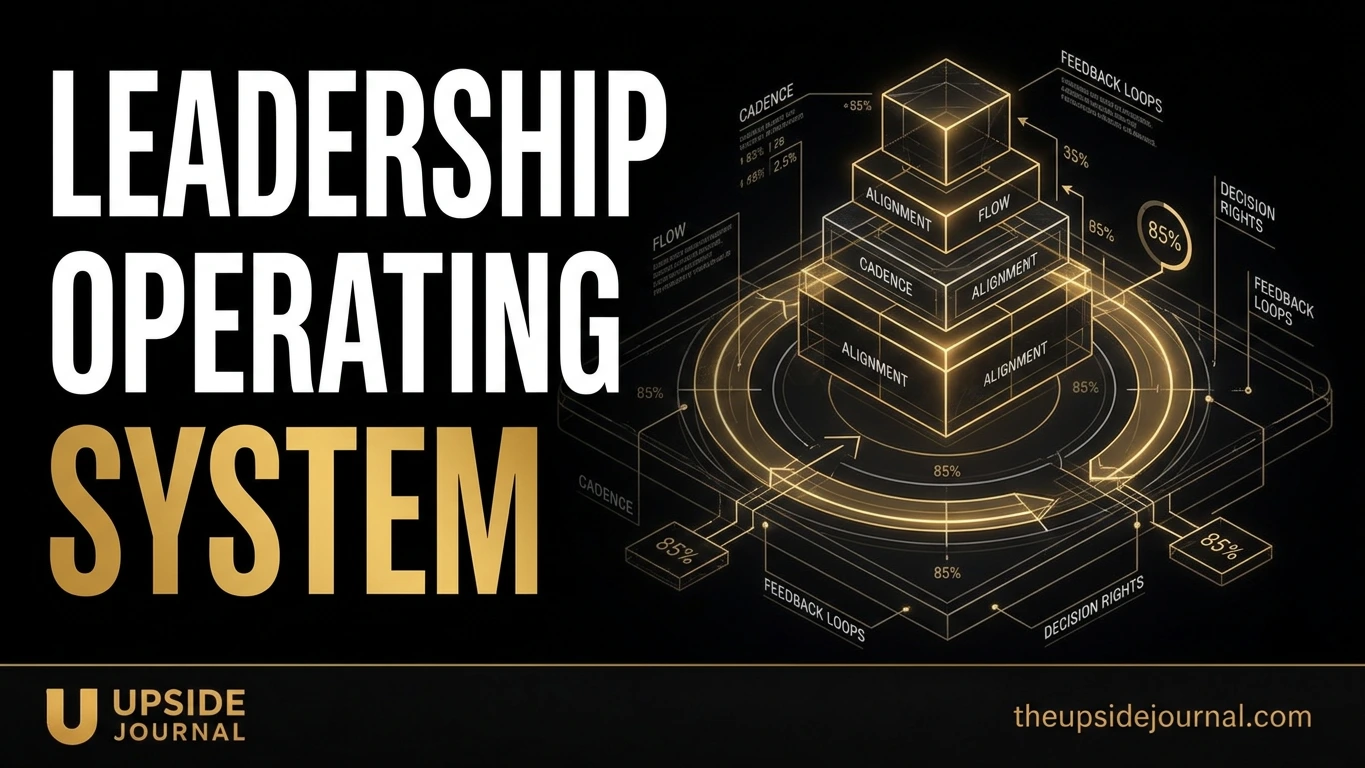
A Leadership Operating System is the codified answer to five questions:
1. Who decides what? (Decision rights)
2. How often do decisions get reviewed? (Cadence)
3. What information reaches decision-makers, and how? (Information architecture)
4. Who is accountable when outcomes miss? (Accountability loops)
5. What happens when something breaks the normal path? (Escalation paths)
This is not a values statement or a leadership philosophy. It is closer to a network topology diagram — and it should be treated with the same rigor. Just as the enterprise AI stack has defined layers, a leadership operating system has defined layers that either connect cleanly or create latency and failure.
See "How to Create an Effective Operating Model"
Framework: The Five Layers of a Leadership Operating System
| Layer | Core Question | Operational Artifact |
|---|---|---|
| Decision Rights | Who can decide, without escalation? | RACI or decision-rights matrix |
| Cadence | How often does review happen? | Weekly/monthly/quarterly rhythm calendar |
| Information Architecture | What data reaches whom, and when? | Dashboards, standing reports, KPI packets |
| Accountability Loops | Who owns the outcome, not just the task? | Owner-of-record assignments per metric |
| Escalation Paths | What breaks the default path, and to whom? | Defined exception triggers and routing |
Why Most Organizations Default to an Undesigned System
Without deliberate design, organizations default to what can be called the founder-as-router model: every decision, regardless of size, routes through one person's judgment because no formal decision rights exist. This works at small scale because the founder has full context. It fails as headcount grows because:
- Context outpaces any single person's attention span.
- Decisions queue, creating latency that compounds across the organization.
- The absence of documented decision rights means every new hire has to learn the system by trial and error, not by reference.
This is the single most common operational failure pattern Upside Journal observes across growth-stage companies, and it is rarely diagnosed correctly. Leadership is blamed for "not delegating" when the actual defect is architectural: there is no system to delegate into.
Technical Breakdown
Decision Rights: The Foundational Layer
Every operating system begins with decision rights — a documented map of who owns which category of decision, and at what threshold a decision requires escalation. Effective decision-rights frameworks specify three tiers:
- Autonomous decisions — made without consultation, reported after the fact.
- Consultative decisions — made by an owner, but require input from named stakeholders first.
- Escalated decisions — routed to a defined higher authority, typically because of cost, risk, or precedent-setting implications.
The single biggest design error is leaving these tiers implicit. Implicit decision rights create two failure modes simultaneously: decisions that should be fast get slowed by unnecessary consultation, and decisions that should be escalated get made unilaterally and surface only after damage is done.
What Companies Get Wrong About Decision Rights - implicit decision rights being the biggest design error — this HBR piece directly backs that claim with Ross School/IMD research on why RACI-style frameworks fail in practice.Cadence: The Heartbeat of the System
Cadence is the rhythm at which the organization reviews itself. A well-designed leadership operating system runs at least three nested cadences:
- Weekly — operational review, near-term execution, blockers.
- Monthly — business performance review against plan, resourcing decisions.
- Quarterly — strategic recalibration, goal-setting, structural changes.
Each cadence layer should have a fixed agenda structure, a standing set of attendees, and a documented output — not a conversation that dissolves the moment the meeting ends. Cadence failure is quietly the most common operational breakdown in growth-stage companies: not the absence of meetings, but meetings with no defined decision output, which convert leadership time into activity without producing accountability.
Information Architecture: What Reaches the Decision-Maker
A leadership operating system is only as good as the information flowing through it. Two failure patterns dominate:
- Information overload — dashboards and reports proliferate without a defined owner or decision tied to each metric, producing noise rather than signal.
- Information starvation — critical operational data never reaches the person with decision rights, so decisions get made on incomplete pictures.
The fix is a KPI ownership model: every metric that appears in a standing report has one named owner accountable for it, and every review cadence has a defined subset of metrics relevant to that specific layer — weekly metrics are leading indicators, monthly metrics are performance indicators, quarterly metrics are structural indicators.
Accountability Loops
Accountability is frequently confused with task assignment. A true accountability loop closes: it defines not just who does the work, but who owns the outcome, how the outcome is measured, and what happens when the outcome misses target. Without a closing mechanism, accountability becomes theoretical — everyone is "responsible," but no one is actually accountable when results disappoint.
Escalation Paths
Every operating system needs a defined exception path — what happens when a decision doesn't fit neatly into the existing rights structure. Escalation paths should specify:
- The trigger condition (cost threshold, customer risk, legal exposure, precedent-setting nature).
- The routing destination (who receives the escalation).
- The expected response time (escalations without SLAs quietly become bottlenecks of their own).
Business Implications
Organizations with a formally designed leadership operating system exhibit measurably different behavior than those without one:
- Faster decision velocity — because decision rights are pre-assigned rather than negotiated case by case.
- Lower founder/executive bandwidth consumption — because routine decisions no longer default to the most senior person in the room.
- Better onboarding for new leaders — because the system, not tribal knowledge, teaches new hires how the organization actually works.
- Reduced single-point-of-failure risk — because institutional memory lives in the system's documented cadence and decision architecture, not solely inside individual leaders' heads.
This directly connects to enterprise resilience during periods of leadership transition, executive turnover, or rapid scaling — situations where undocumented, personality-dependent leadership systems collapse first.
Capital Implications
Investors increasingly diligence operating systems, not just financial metrics, particularly at Series B and beyond. A founder who can articulate their decision-rights framework, cadence structure, and accountability model signals institutional readiness — the organization can absorb capital and scale without leadership becoming the bottleneck.
Conversely, undesigned leadership systems are a quiet but material risk factor: they correlate with the kind of operational breakdown described in why growth breaks companies: operational complexity, where capital deployed into growth outpaces the organization's actual capacity to execute against it. Operating system maturity is, in effect, a leading indicator of capital efficiency.
Operator Playbook
A practical sequence for designing or auditing a leadership operating system:
1. Map current decision flow. Document how the last ten significant decisions were actually made — not how the org chart implies they should be made.
2. Build a decision-rights matrix. Assign autonomous, consultative, and escalated tiers to major decision categories.
3. Design the cadence calendar. Define weekly, monthly, and quarterly review structures with fixed agendas and required outputs.
4. Assign KPI ownership. Every recurring metric gets one named owner and one home cadence layer.
5. Document escalation triggers. Define what breaks the default path and where it routes.
6. Audit quarterly. Treat the operating system itself as a product — review it, revise it, and retire what no longer serves the organization's current scale.
This playbook mirrors the discipline described in from manager to operator: the leadership skill stack, where the shift from managing tasks to operating systems marks the actual inflection point in a leader's development.
Long Horizon View
As organizations increasingly run on AI-assisted execution layers, the leadership operating system becomes the primary differentiator between companies that scale cleanly and those that scale chaotically. AI compresses execution time, but it does not compress the need for clear decision rights — if anything, it raises the cost of ambiguity, because decisions now need to be made and communicated at machine-adjacent speed.
Over the next decade, expect leadership operating systems to become as formally documented and audited as technology architecture — reviewed by boards, referenced in diligence, and treated as a core piece of enterprise infrastructure rather than a soft leadership preference.
Contrarian Perspective
The conventional narrative holds that leadership scales through better leaders — more experienced hires, stronger executive coaching, more charismatic communicators. This is only partially true, and it is frequently a distraction from the real fix.
An organization with a strong leader operating inside a weak system will eventually produce the same bottlenecks as an organization with a weak leader — because the system, not the individual, determines whether decisions scale. Hiring "better leaders" without redesigning the operating system underneath them is a common and expensive misdiagnosis. The system is the more durable investment; the individual leader is the more visible — but less structurally important — one.
Key Takeaways
- A Leadership Operating System has five layers: decision rights, cadence, information architecture, accountability loops, and escalation paths.
- Most operational leadership failure is a cadence and decision-rights failure, not a talent failure.
- Institutional memory should live in the system, not exclusively in individual leaders.
- Investors increasingly treat operating system maturity as a proxy for capital efficiency and execution risk.
- The leadership operating system should be documented, diagrammed, and audited like any other piece of enterprise infrastructure.
Conclusion
Operational leadership is not a leadership style. It is a designed system — and like any system, it can be diagrammed, audited, and improved. Organizations that treat leadership as infrastructure rather than personality build the kind of durable execution capacity that survives founder transitions, scaling shocks, and market volatility. Those that don't will keep rediscovering, expensively, that their best leader was never a substitute for a real operating system.
Frameworks Referenced in This Piece
The frameworks and research cited in this article are drawn from the following sources. Upside Journal may earn a commission on qualifying purchases through Amazon links below, at no additional cost to you. Our editorial recommendations are independent of any commission arrangement.
Resource: Traction — Gino Wickman
Why It's Referenced: Origin of the weekly/monthly/quarterly cadence model this article builds on.
Get It: Amazon →
Resource: Scaling Up — Verne Harnish
Why It's Referenced: Broader operating-system framing that complements the cadence architecture discussed above.
Get It: Amazon →
Want the full system as a working tool, not just a framework? The Leadership Operating System packages every layer covered in this article — Weekly Scorecard, Monthly Business Review, QBR, Annual Planning Canvas, and Decision Governance — into a ready-to-use PDF workbook plus companion Google Sheets tracker. Built specifically to run the cadence above, not a generic template pack.
Get The Leadership Operating System →