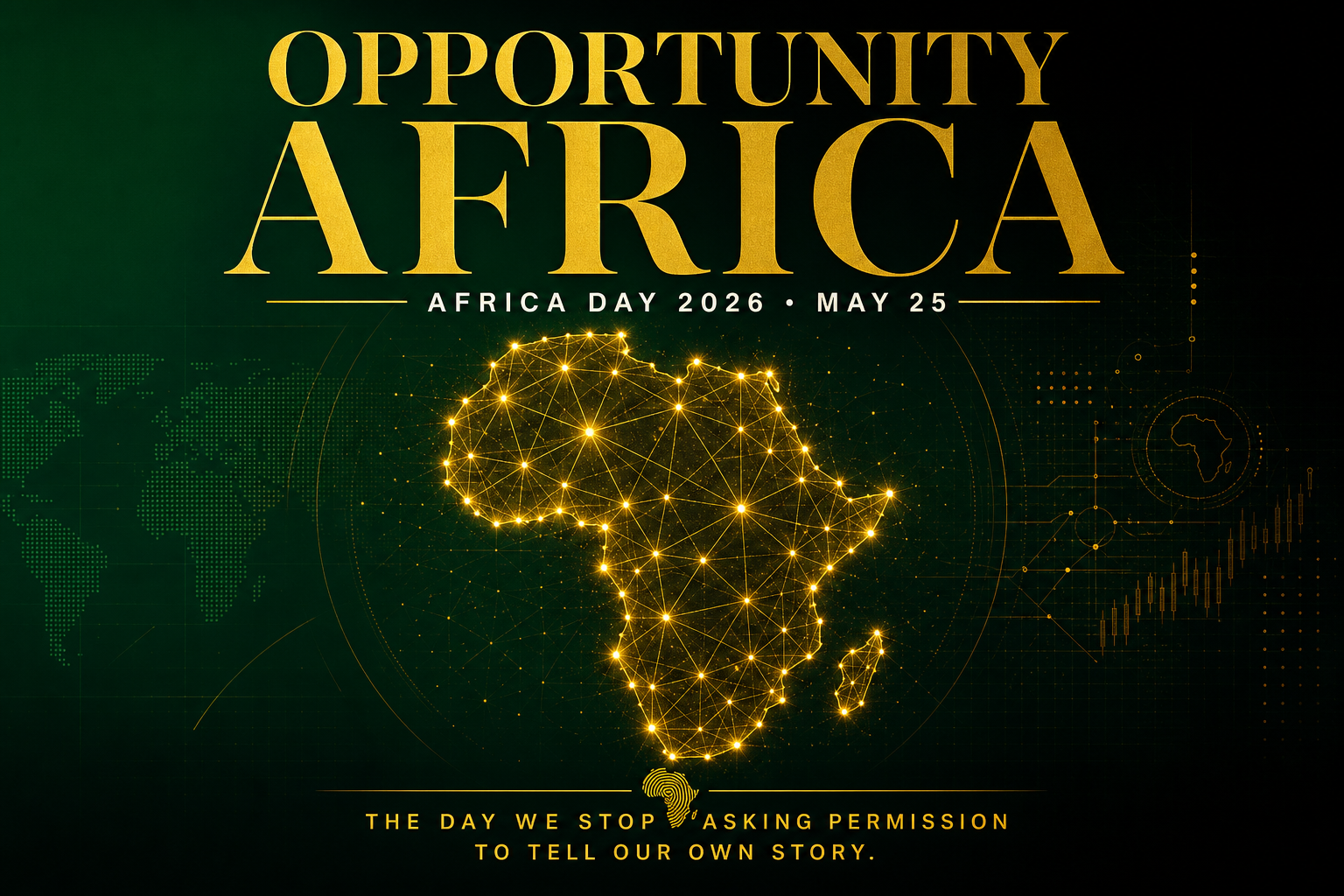
On May 25, 1963, thirty-two African heads of state walked into a hall in Addis Ababa and signed a document that created the Organisation of African Unity. Sixty-three years later, most of the world still hasn't read it.
That's the problem with Africa's story. It exists — it's extraordinary — but the people telling it haven't been us. And the cost of that isn't just cultural. It's economic.
A 2024 study by Africa No Filter found that negative media framing costs the continent an estimated $4.2 billion annually in lost investment and tourism revenue. The narrative deficit isn't abstract. It shows up in term sheets, in visa queues, in boardroom assumptions about what African markets can and cannot do.
Today — Africa Day 2026 — something different is happening.
What Is Opportunity Africa?
Storytellers, entrepreneurs, creatives, leaders, and workers across the continent and diaspora are taking part in a coordinated digital movement to change how the world sees Africa — and how we, as Africans, see ourselves.
It's called Opportunity Africa. And it's not a one-day hashtag.
On the 25th of every month for the next twelve months, we will flood the internet with stories of the people, places, ideas, initiatives, businesses, and movements driving Africa forward. Not the sanitised version. Not the charity version. The real version — the one built by the people who stayed, the people who returned, and the people creating opportunity every single day.
Why This Matters Now
Africa's economy is projected to grow 4.0% in 2026, according to the latest UN World Economic Situation and Prospects report. East Africa alone is expected to hit 5.8% — driven by Ethiopia and Kenya's expanding tech and renewable energy sectors. The continent has the world's youngest population, its fastest-growing middle class, and a startup ecosystem that raised over $2.2 billion in venture funding last year despite a global downturn.
Those numbers exist. But they don't trend on social media. They don't make the CNN chyron. They don't shape the instinctive response when a European fund manager hears "Africa."
What does shape it? Crisis headlines. Conflict footage. Poverty imagery used by NGOs whose funding models depend on your pity, not your respect.
This is not about ignoring Africa's challenges. Every continent has them. But no other continent is defined exclusively by its hardest chapters.
The Builders
I've sat across from founders in Lagos building AI tools that outperform Silicon Valley equivalents on local datasets. I've watched entrepreneurs in Nairobi create payment infrastructure that makes European banking look archaic. I've seen creatives in Accra, Johannesburg, and Kigali produce work that is setting global trends, not following them.
These stories don't need to be invented. They need to be amplified.
That's what Opportunity Africa is: a commitment to show up, every month, with the stories that the world's media has decided aren't worth the airtime. The builders. The innovators. The people who wake up every morning in Kinshasa, Dar es Salaam, Abidjan, and Addis Ababa and choose to build — despite systems that were never designed to support them.
A New Kind of Independence
Sixty-three years after African leaders gathered to declare political sovereignty, we are fighting for something equally important: narrative sovereignty.
The right to define what Africa is, to decide which stories matter, and to ensure that the world sees us as we are — not as a crisis to be managed, but as an opportunity to be seized.
That's why Upside Journal exists. That is why I write. And that is why, today and every 25th for the next year, we are joining Opportunity Africa.
The question was never whether Africa has opportunity. The question is whether the world is ready to stop looking away.
One continent. Fifty-four nations. Sixty-three years of political independence. And a new fight — for the right to tell our own story.
We're done waiting for that answer. We're telling the story ourselves.
Related: Yesterday we published 35 Years of Eritrea — Why Every African Independence Story Is My Story Too, reflecting on what sovereignty means for this generation of African founders. The two pieces are companion reads.CI
Chaste Inegbedion is the Editor-in-Chief of Upside Journal and founder of The Pitch Journey. He writes about the intersection of African sovereignty, technology, and capital. Follow him on X and LinkedIn.